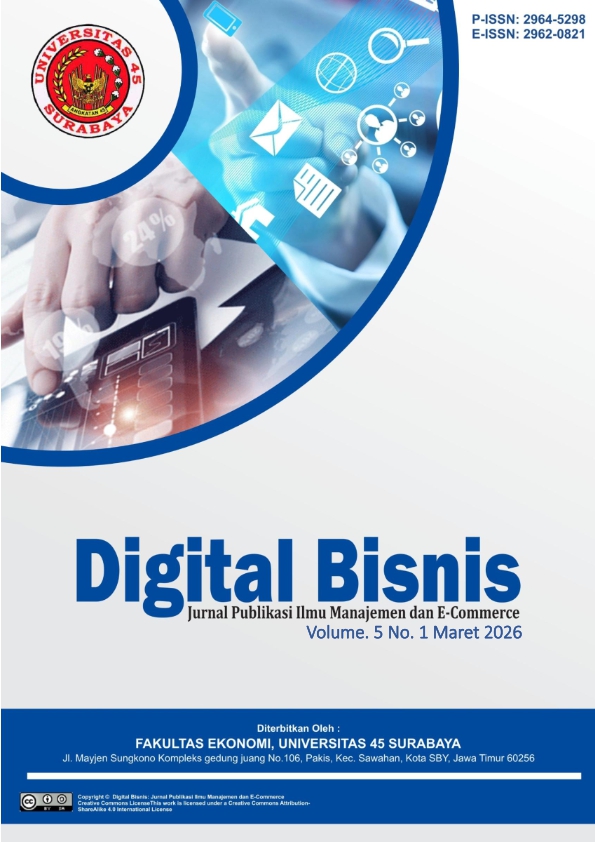
Pengaruh Sharing Project dan Motivasi Kerja terhadap Kinerja Guru melalui Profesionalitas Kerja Guru
DOI:
https://doi.org/10.30640/digital.v5i2.6956Keywords:
Mazaya Assunnah School, Project Sharing, Teacher Performance, Work Motivation, Work ProfessionalismAbstract
This study aims to analyze the influence of project-creation knowledge sharing and work motivation on teacher performance, mediated by teacher professionalism, at Mazaya Assunnah School. The study is motivated by the importance of enhancing teacher performance to meet the demands of 21st-century education, which requires collaboration, high motivation, and continuous professionalism. A quantitative approach with a causal design was employed. The study population consisted of all 51 teachers at Mazaya Assunnah School, all of whom were included in the sample using a saturated sampling technique. Data were collected via Likert-scale questionnaires and analyzed using the Partial Least Squares-Structural Equation Modeling (PLS-SEM) method with SmartPLS 4 software. The results indicate that project-creation knowledge sharing has a positive and significant effect on teacher performance, as do teacher professionalism and work motivation. Furthermore, teacher professionalism was found to partially mediate the influence of project-creation knowledge sharing and work motivation on teacher performance. The study concludes that improving the quality of project-creation knowledge sharing and work motivation can enhance teacher professionalism, ultimately leading to improved teacher performance and the quality of education at the school.
References
Astrada, F., Madiistriyatno, H., & Ningsih, S. W. (2024). Pengaruh gaya kepemimpinan, motivasi, dan disiplin kerja terhadap kinerja karyawan. Jurnal Jasmien, 4(4), 238–248.
Badan Pusat Statistik. (2024). Statistik pendidikan Indonesia 2024. BPS.
Baron, R. M., & Kenny, D. A. (1986). The moderator-mediator variable distinction in social psychological research. Journal of Personality and Social Psychology, 51(6), 1173–1182. https://doi.org/10.1037/0022-3514.51.6.1173
Chin, W. W. (1995). Partial least squares is to LISREL as principal components analysis is to common factor analysis. Technology Studies, 2(2), 315–319.
Chin, W. W., Gopal, A., & Salisbury, W. D. (1997). Advancing the theory of adaptive structuration. Information Systems Research, 8(4), 342–367. https://doi.org/10.1287/isre.8.4.342
Cooper, D. R., Schindler, P. S., & Sun, J. (2006). Business research methods (9th ed.). McGraw-Hill.
Danielson, C. (2013). The framework for teaching: Evaluation instrument. ASCD.
Day, C., & Qing, G. (2009). Teacher professionalism: Why and how it matters. Educational Review, 61(1), 1–19.
Deci, E. L., & Ryan, R. M. (2000). The “what” and “why” of goal pursuits. Psychological Inquiry, 11(4), 227–268.
Deci, E. L., & Ryan, R. M. (2020). Self-determination theory: Basic psychological needs in motivation, development, and wellness. Guilford Publications.
Direktorat GTK. (2023). Laporan penerapan project based learning di sekolah. Kemdikbudristek.
Duarte, P., & Raposo, M. (2010). A PLS model to study brand preference. Esic Market Economics and Business Journal, 41(1), 39–62.
DuFour, R., & Eaker, R. (2016). Professional learning communities at work (2nd ed.). Solution Tree Press.
Ferdinand, A. (2005). Structural equation modeling dalam penelitian manajemen. UNDIP Press.
Ferdinand, A. (2006). Metode penelitian manajemen. UNDIP Press.
Fullan, M. (2016). The new meaning of educational change (5th ed.). Teachers College Press.
Fullan, M., & Quinn, J. (2020). Collaborative impact. Jossey-Bass.
Garson, G. D. (2016). Partial least squares. Statistical Associates Publishing.
Hair, J. F., Hult, G. T. M., Ringle, C. M., & Sarstedt, M. (2014). A primer on partial least squares structural equation modeling (PLS-SEM) (2nd ed.). Sage.
Hair, J. F., Ringle, C. M., & Sarstedt, M. (2011). PLS-SEM: Indeed a silver bullet. Journal of Marketing Theory and Practice, 19(2), 139–152. https://doi.org/10.2753/MTP1069-6679190202
Hamdani, D., Madiistriyatno, H., & Adiputra, I. G. (2026). Pengaruh kerja sama tim dan komunikasi terhadap kinerja pegawai.
Han, J., & Yin, H. (2021). Teacher motivation. Educational Psychology Review, 33(4), 1477–1504.
Hargreaves, A., & Fullan, M. (2020). Professional capital (2nd ed.). Teachers College Press.
Hargreaves, A., & O’Connor, M. T. (2018). Collaborative professionalism. Corwin Press.
Hartono, J. (2008). Metodologi penelitian. BPFE.
Hasibuan, M. S. P. (2019). Manajemen sumber daya manusia. Bumi Aksara. https://doi.org/10.31219/osf.io/x3j64
Hattie, J. (2009). Visible learning. Routledge. https://doi.org/10.4324/9780203887332
Hoy, W. K., & Miskel, C. G. (2018). Educational administration (10th ed.). McGraw-Hill.
Johnson, D. W., & Johnson, R. T. (2014). Cooperation and the use of technology. In R. E. Slavin, Educational psychology. Pearson.
Kementerian Pendidikan, Kebudayaan, Riset, dan Teknologi. (2023). Laporan statistik guru dan tenaga kependidikan. Kemendikbudristek.
Kementerian Pendidikan, Kebudayaan, Riset, dan Teknologi. (2024). Profil guru Indonesia 2024. Kemendikbudristek.
Lieberman, A., & Miller, L. (2014). Teachers in professional communities. Teachers College Press.
Madiistriyatno, H. (2020). Pengaruh motivasi kerja terhadap kinerja pegawai. Jurnal Ilmu Manajemen.
Madiistriyatno, H., & Santoso, I. (2021). Metodologi penelitian kuantitatif. Erlangga.
Madiistriyatno, H., et al. (2023). Menumbuhkan kemandirian warga binaan melalui motivasi berwirausaha. Selaras: Jurnal Pengabdian Masyarakat.
Madiistriyatno, H., Hanafi, H., et al. (2024). The effect of motivation and job satisfaction on nurse performance. Jurnal Ekonomi, 5(2), 123–130.
Mangkunegara, A. P. (2017). Manajemen sumber daya manusia perusahaan. Remaja Rosdakarya.
Meriasih, D., Madiistriyatno, H., & Taufik. (2026). Education level and teaching experience as determinants of teacher competence in rural Islamic primary schools. Al-Tanzim: Jurnal Manajemen Pendidikan Islam. https://doi.org/10.33650/al-tanzim.v10i1.12802
Nurhasan, Sahim, A. N., & Nengsih, W. (2025). The influence of work motivation and work discipline on teacher performance at SDN Kebalen 02 Bekasi. Journal Informatic, Education and Management (JIEM), 8(1), 371–383.
Pratiwi, R., et al. (2022). Kolaborasi guru dalam pembelajaran berbasis proyek. Jurnal Pendidikan Inovatif, 6(1), 45–56.
Rahmawati, N., & Nugroho, S. (2023). Motivasi dan profesionalitas terhadap kinerja guru. Jurnal Ilmu Pendidikan, 18(1), 12–25.
Ringle, C. M., et al. (2018). PLS-SEM in HRM research. The International Journal of Human Resource Management, 29(12), 1–27.
Robbins, S. P., & Judge, T. A. (2017). Organizational behavior (17th ed.). Pearson.
Sari, D., et al. (2024). Peran kolaborasi guru terhadap kinerja. Jurnal Penelitian Pendidikan, 20(2), 67–79.
Schön, D. A. (2017). The reflective practitioner. Routledge. https://doi.org/10.4324/9781315237473
Sekaran, U., & Bougie, R. (2016). Research methods for business: A skill-building approach (7th ed.). Wiley.
Sekaran, U., & Bougie, R. (2020). Research methods for business (8th ed.).
Senge, P. M. (2016). The fifth discipline. Doubleday.
Skaalvik, E. M., & Skaalvik, S. (2022). Teacher motivation and well-being. Educational Psychology, 42(2), 121–138.
Sugiyono. (2004). Metode penelitian. Alfabeta.
Sugiyono. (2022). Metode penelitian pendidikan. Alfabeta.
Sutrisno, A., & Wibowo, B. (2021). Pengaruh motivasi kerja terhadap kinerja guru. Jurnal Manajemen Pendidikan, 15(2), 85–97. https://doi.org/10.30596/jmp-dmt.v2i1.7110
Thomas, J. W. (2020). Project-based learning. Buck Institute.
Tim Pengembang Pendidikan. (2021). Laporan pengembangan profesional guru. Kemdikbudristek.
Undang-Undang Republik Indonesia Nomor 14 Tahun 2005 tentang Guru dan Dosen.
Downloads
Published
Issue
Section
License
Copyright (c) 2026 Devi Nurul Hikmi, Aswin Naldi Sahim, Sukiman Sukiman

This work is licensed under a Creative Commons Attribution-ShareAlike 4.0 International License.