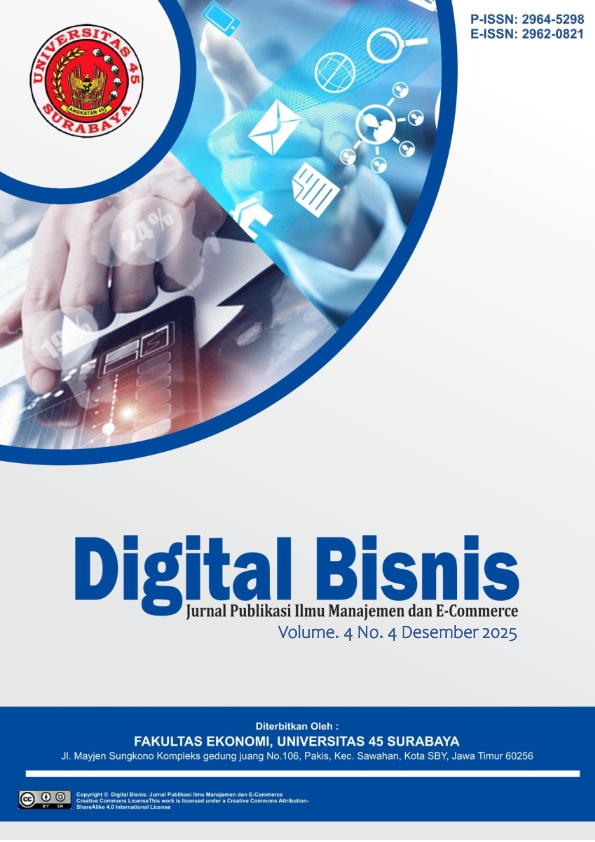
Peran Media Sosial dalam Strategi Bisnis pada Mahasiswa
DOI:
https://doi.org/10.30640/digital.v4i4.5634Keywords:
Business Strategy, Digital Business, Digital Marketing, Social Media, StudentsAbstract
The waste crisis in Indonesia requires creative and innovative approaches that go beyond traditional regulatory measures alone. This study examines the application of nudging strategies in public policy as an effort to encourage behavioral change toward sustainable consumption and the formation of zero-waste communities. The research employs a qualitative approach through a literature review and comparative analysis of relevant waste management policies and practices. The findings identify five main nudging strategies—default options, social norms, simplification, framing, and salience—which have the potential to influence individual decision-making in a non-coercive manner. The results indicate that nudging strategies are more effective in shaping environmentally friendly behavior when supported by adequate infrastructure and active involvement from government, the private sector, and the community. The implementation of packaging return systems, simplification of waste sorting processes, and social norm–based campaigns have proven effective in increasing public participation and awareness. However, major challenges remain, including limited infrastructure, high consumption patterns, and weak coordination among stakeholders. Therefore, this study recommends the development of an integrated policy model that combines nudging strategies, economic incentives, and local regulations to accelerate the transition toward a zero-waste society in Indonesia.
References
Ardianto, E. (2018). Metodologi penelitian untuk public relations kuantitatif dan kualitatif. Simbiosa Rekatama Media.
Chaffey, D. (2015). Digital business and e-commerce management. Pearson Education.
Creswell, J. W. (2014). Research design: Qualitative, quantitative, and mixed methods approaches. SAGE Publications.
Kaplan, A. M., & Haenlein, M. (2010). Users of the world, unite! The challenges and opportunities of social media. Business Horizons, 53(1), 59–68.
Kietzmann, J. H., Hermkens, K., McCarthy, I. P., & Silvestre, B. S. (2011). Social media? Get serious! Business Horizons, 54(3), 241–251.
Kotler, P., & Keller, K. L. (2016). Marketing management (15th ed.). Pearson Education.
Laudon, K. C., & Traver, C. G. (2020). E-commerce: Business, technology, society (16th ed.). Pearson.
Mangold, W. G., & Faulds, D. J. (2009). Social media: The new hybrid element of the promotion mix. Business Horizons, 52(4), 357–365.
Miles, M. B., & Huberman, A. M. (2014). Qualitative data analysis. SAGE Publications.
Nasrullah, R. (2017). Media sosial: Perspektif komunikasi, budaya, dan sosioteknologi. Simbiosa Rekatama Media.
Porter, M. E. (2008). Competitive strategy: Techniques for analyzing industries and competitors. Free Press.
Ryan, D. (2016). Understanding digital marketing. Kogan Page.
Strauss, J., & Frost, R. (2014). E-marketing (7th ed.). Pearson.
Sugiyono. (2019). Metode penelitian kualitatif, kuantitatif, dan R&D. Alfabeta.
Tuten, T. L., & Solomon, M. R. (2017). Social media marketing. SAGE Publications.
Downloads
Published
Issue
Section
License
Copyright (c) 2025 Digital Bisnis: Jurnal Publikasi Ilmu Manajemen dan E-Commerce

This work is licensed under a Creative Commons Attribution-ShareAlike 4.0 International License.