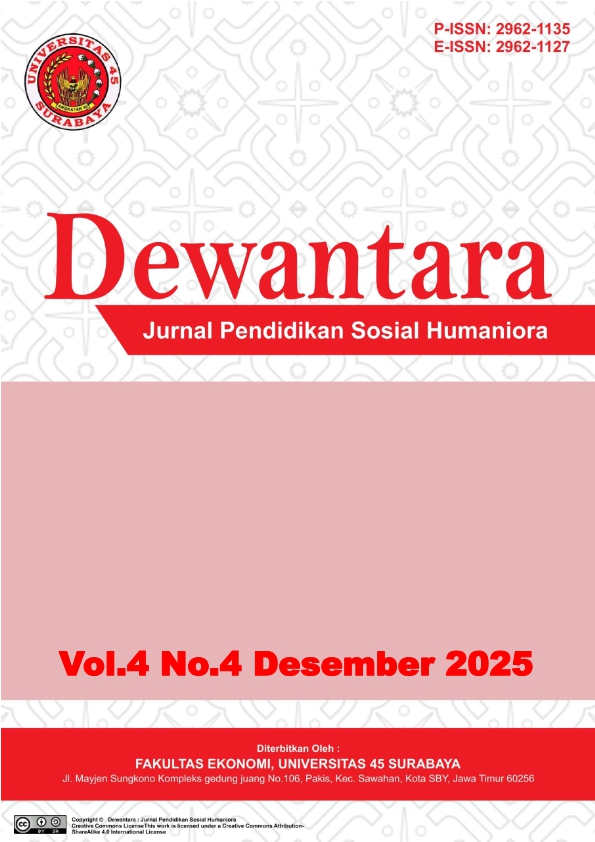
Pengelolaan Bendung Konga sebagai Pemasok Air Bagi Pertanian di Desa Konga Kecamatan Titehena Kabupaten Flores Timur
DOI:
https://doi.org/10.30640/dewantara.v5i1.7353Keywords:
Agriculture, Institutional Governance, Irrigation, Water Resources, Water Resources ManagementAbstract
Sustainable reservoir management plays an essential role in ensuring the availability of irrigation water for agricultural development, particularly in regions that depend on surface water resources. This study aims to analyze the management of Konga Dam as a water supplier for agriculture in Konga Village, Titehena District, East Flores Regency based on four management dimensions: planning, utilization, controlling, and maintenance. This study employed a qualitative descriptive approach. Data were collected through field observations, in-depth interviews, and documentation, and analyzed using the interactive model of Miles, Huberman, and Saldaña, consisting of data reduction, data display, and conclusion drawing. Data validity was ensured through source, technique, and time triangulation. The findings indicate that the management of Konga Dam involves the Nusa Tenggara II River Basin Agency, the Public Works and Spatial Planning Office of East Nusa Tenggara Province, the Public Works Office of East Flores Regency, dam operational officers, water gate operators, Water User Farmers Associations, the village government, and local communities. Nevertheless, management effectiveness remains constrained by weak institutional coordination, unequal water distribution, limited supervision, and irregular infrastructure maintenance. The study concludes that sustainable management of Konga Dam requires stronger institutional governance, improved stakeholder coordination, and active community participation to ensure equitable and sustainable irrigation water distribution.
References
Benson, D., Gain, A. K., & Rouillard, J. J. (2015). Water governance in a comparative perspective: From IWRM to a "nexus" approach? Water Alternatives, 8(1), 756–773.
Food and Agriculture Organization. (2021). The state of the world's land and water resources for food and agriculture: Systems at breaking point (SOLAW 2021). FAO. https://doi.org/10.4060/cb7654en
Food and Agriculture Organization. (2023). The state of food and agriculture 2023: Revealing the true cost of food to transform agrifood systems. FAO. https://doi.org/10.4060/cc7724en
García, M. M., Hileman, J., & Bodin, Ö. (2019). Collaboration and conflict in complex water governance systems across a development gradient: Addressing common challenges and solutions. Ecology and Society, 24(3). https://doi.org/10.5751/ES-11133-240328
Gie, E., Rihi, D. W., Isliko, T. W. A., Benyamin, R. A., Ibiruni, W. F. U., & Ndun, W. N. (2025). Analysis of water governance on declaration construction for water supply resilience for dry land agriculture (Study in Kupang District, NTT Province). International Journal of Environmental, Sustainability, and Social Science, 6(1), 134–148. https://doi.org/10.38142/ijesss.v6i1.1227
Kartasasmita, G. (1997). Administrasi pembangunan: Perkembangan, pemikiran, dan praktiknya di Indonesia. PT Pustaka LP3ES Indonesia.
Kementerian Pekerjaan Umum dan Perumahan Rakyat Republik Indonesia. (2015). Peraturan Menteri Pekerjaan Umum dan Perumahan Rakyat Republik Indonesia Nomor 14/PRT/M/2015 tentang kriteria dan penetapan status daerah irigasi.
Miles, M. B., Huberman, A. M., & Saldaña, J. (2014). Qualitative data analysis: A methods sourcebook (3rd ed.). SAGE Publications.
Moleong, L. J. (2007). Metodologi penelitian kualitatif (Edisi revisi). PT Remaja Rosdakarya.
Peraturan Pemerintah Republik Indonesia Nomor 30 Tahun 2024 tentang Pengelolaan Sumber Daya Air. (2024). Lembaran Negara Republik Indonesia Tahun 2024 Nomor 30.
Peraturan Pemerintah Republik Indonesia Nomor 37 Tahun 2010 tentang Bendungan. (2010). Lembaran Negara Republik Indonesia Tahun 2010 Nomor 37.
Rosyidah, S., & Nugraheni, A. (2021). Angewandte Chemie International Edition, 7(1), 37–60.
Satriyadi, W. (2022). Evaluasi kinerja pengelolaan jaringan irigasi di Desa Kakiang Kecamatan Moyo Hilir Kabupaten Sumbawa Besar (Skripsi, Universitas Muhammadiyah Mataram).
Soedibyo, I. (2003). Teknik bendungan. PT Pradnya Paramita.
Sugiyono. (2020). Metode penelitian kuantitatif, kualitatif, dan R&D (2nd ed.). Alfabeta.
Terry, G. R. (1977). Principles of management (7th ed.). Richard D. Irwin, Inc.
Undang-Undang Republik Indonesia Nomor 17 Tahun 2019 tentang Sumber Daya Air. (2019). Lembaran Negara Republik Indonesia Tahun 2019 Nomor 190.
Undang-Undang Republik Indonesia Nomor 32 Tahun 2009 tentang Perlindungan dan Pengelolaan Lingkungan Hidup. (2009). Lembaran Negara Republik Indonesia Tahun 2009 Nomor 140.
Wadu, J., Lay, M. R., Toda, H., Rihi, D. W., & Nifu, Y. I. (2023). Water governance analysis in the development of embung for water supply security for agriculture (Study in Sabu Raijua District, NTT Province). International Journal of Social Science and Human Research, 6, 3613–3627. https://doi.org/10.55324/josr.v2i10.1437
Wadu, J., Lay, M. R., Toda, H., Rihi, D. W., & Nifu, Y. I. (2023). Pengelolaan sistem irigasi dan tata kelola sumber daya air di Nusa Tenggara Timur.
Downloads
Published
How to Cite
Issue
Section
License
Copyright (c) 2026 Agnes Stefani Koten, Jacob Wadu, David Wilfrid Rihi

This work is licensed under a Creative Commons Attribution-ShareAlike 4.0 International License.