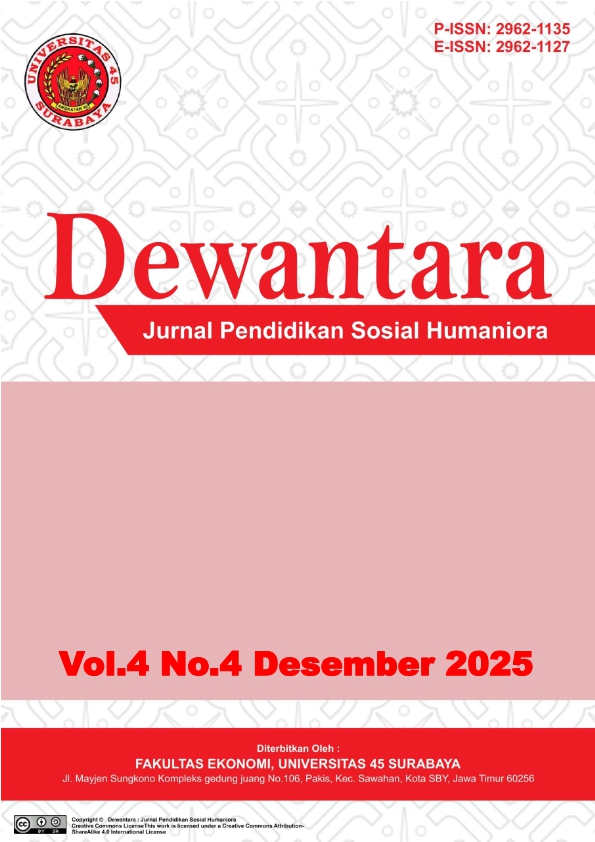
Konstruksi Sosial Identitas “Muslim Ideal” dalam Perilaku Belajar Peserta Didik Analisis Relasi Kuasa dan Epistemologi Pendidikan Islam di SDIT Kayyatal Jihaaz
DOI:
https://doi.org/10.30640/dewantara.v5i1.6897Keywords:
Islamic Epistemology, Power Relations, Psychological Learning Behavior, SDIT Kayyatal Jihaaz, Social ConstructionAbstract
This study critically explores psychological learning behavior within the social construction of the “ideal Muslim” identity among students at SDIT Kayyatal Jihaaz PPI 220 Margaluyu, Tanjungsari, Sumedang. Using a qualitative-critical approach with a case study design, this research examines the interaction between students’ psychological dynamics, daily learning practices, and the institutional environment that shapes religious identity formation. The theoretical framework integrates Berger and Luckmann’s sociology of knowledge, Skinner’s behaviorist psychology, Bandura’s social cognitive theory, Foucault and Bourdieu’s perspectives on power relations, and Islamic educational epistemology. Data were analyzed to reveal how school rules, teacher authority, symbolic discipline, and repeated religious routines influence students’ obedience, motivation, and self-perception within everyday school life. The findings indicate that psychological manifestations in children’s learning behavior are produced through externalization, objectivation, and internalization of value systems mediated by the symbolic power of teachers. Formal compliance at the surface level often conceals passive psychological resistance caused by rigid regulatory dominance. This study formulates the Reflective Islamic Identity Construction model as a strategic framework to transform formalistic piety into a more authentic, reflective, and internalized Muslim identity.
References
Anwar, K., & Rosyid, A. (2024). Modifikasi perilaku keagamaan berbasis reward dan punishment di sekolah dasar Islam terpadu. Jurnal Psikologi Pendidikan Dan Konseling, 10(1), 45-58.
Bandura, A. (2020). Social cognitive theory: An agentic perspective on human development. Harvard University Press.
Berger, P. L., & Luckmann, T. (1966). The social construction of reality: A treatise in the sociology of knowledge. Anchor Books.
Daulay, H. P. (2022). Epistemologi pendidikan Islam konsep ta’dib Syed Muhammad Naquib al-Attas dan relevansinya di Indonesia. Jurnal Pendidikan Islam Indonesia, 6(2), 143–156.
Fahyuni, E. F., & Rohmah, S. (2023). Problematika misbehavior verbal pada anak usia sekolah dasar berbasis full-day school di Jawa Barat. Jurnal Counseling Komprehensif, 10(2), 154-168.
Fakhrunnisa, A., & Muqowim, M. (2023). Strategi pengelolaan kesehatan mental anak usia dasar dalam menghadapi kejenuhan kurikulum terpadu. Jurnal Pendidikan Anak Usia Dini, 7(2), 201-215.
Hanafi, Y., Taufiq, A., & Fahrudin, M. (2024). Transforming formalistic piety into reflective religious habitus: A case study of Indonesian integrated Islamic schools. Journal of Beliefs & Values, 45(1), 78-94.
Ilham, M., & Suyatno, S. (2023). Internalisasi nilai-nilai adab (ta’dib) dalam kurikulum sekolah dasar Islam terpadu: Studi kritis relasi guru-murid. Jurnal Pendidikan Islam, 45(1), 189–204.
Lisna Anggi Putri, Muhammad Dawud Abdul Halim, Mochammad Shafwan Daffa, Ariya Aurel Megantara, Syavira Maharani Nurjaman, Erika Rahmadani, & Supriyono Supriyono. (2025). Konstruksi Sosial Selebriti di Dunia Politik: Implikasi Pendidikan dan Pengaruh Media. 2(1), 08–20. https://doi.org/https://doi.org/10.61132/jucapenbi.v2i1.135
Muafiah, N., & Munardji, M. (2023). Analisis perilaku splitting pada anak usia sekolah dasar dalam lingkungan pengawasan asimetris. Jurnal Psikologi Perkembangan, 15(1), 67-82.
Rahmat, C., & Hasanah, U. (2023). Evaluasi efektivitas program mutabaah yaumiyah digital terhadap kedisiplinan ibadah siswa. Jurnal Ilmiah Peuradeun, 11(3), 895-912.
Sahrandi, A., & Jaelani, A. (2023). Aplikasi konsep tazkiyatun nafs Imam Al-Ghazali dalam metode konseling anak usia dini. Jurnal Bimbingan Dan Konseling Islam, 10(1), 12-27.
Sudarsono, B., & Kurniawan, A. (2024). Kuasa simbolik dan kontestasi habitus kesalehan di sekolah dasar berbasis ormas keagamaan. Jurnal Sosiologi Pendidikan Humanis, 9(1), 32–47.
Zarkasyi, H. F. (2021). Pola gerakan ganda (double movement) Fazlur Rahman dalam rekonstruksi pendidikan tinggi Islam kontemporer. Jurnal Tsaqafah, 17(2), 241-258.
Zuhdi, M., & Rahmawati, E. (2024). Pseudo-piety: Kepatuhan semu dalam psikologi perkembangan anak di lingkungan full-day school. Jurnal Psikologi Islami, 11(2), 112-126.
Downloads
Published
How to Cite
Issue
Section
License
Copyright (c) 2026 Supian Munawar

This work is licensed under a Creative Commons Attribution-ShareAlike 4.0 International License.